



Hydraulic Cylinder Welding Machine With Robot Station
Robotic welding station for hydraulic cylinder barrel seams, contoured piston rod-end joints, and square valve seats using mixed-gas shielded welding.
Description
Hydraulic Cylinder Welding Machine with Robot Station
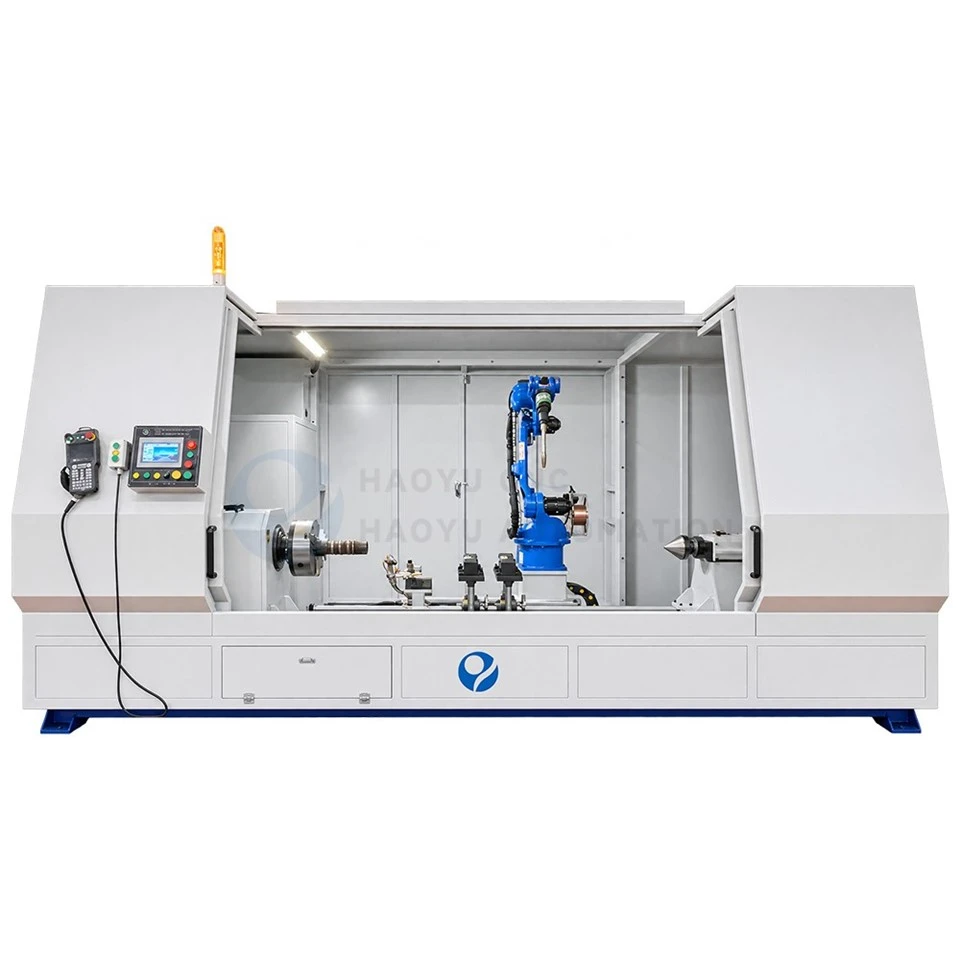
The Hydraulic Cylinder Welding Machine with Robot Station is designed for manufacturers looking to improve workpiece positioning and weld path repeatability in hydraulic cylinder production. It performs cylinder barrel circumferential welding, contoured piston rod-end welding, and square valve seat welding using a mixed-gas shielded welding process.
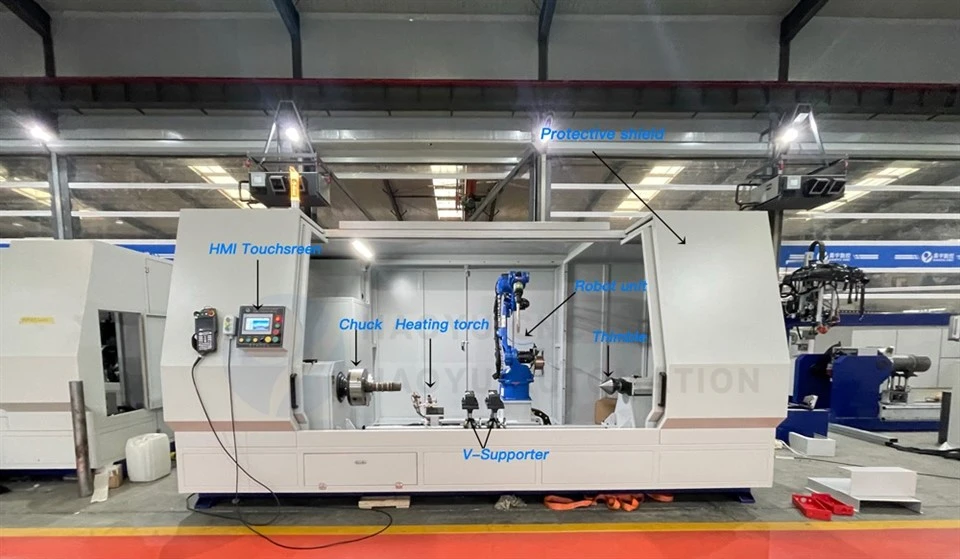
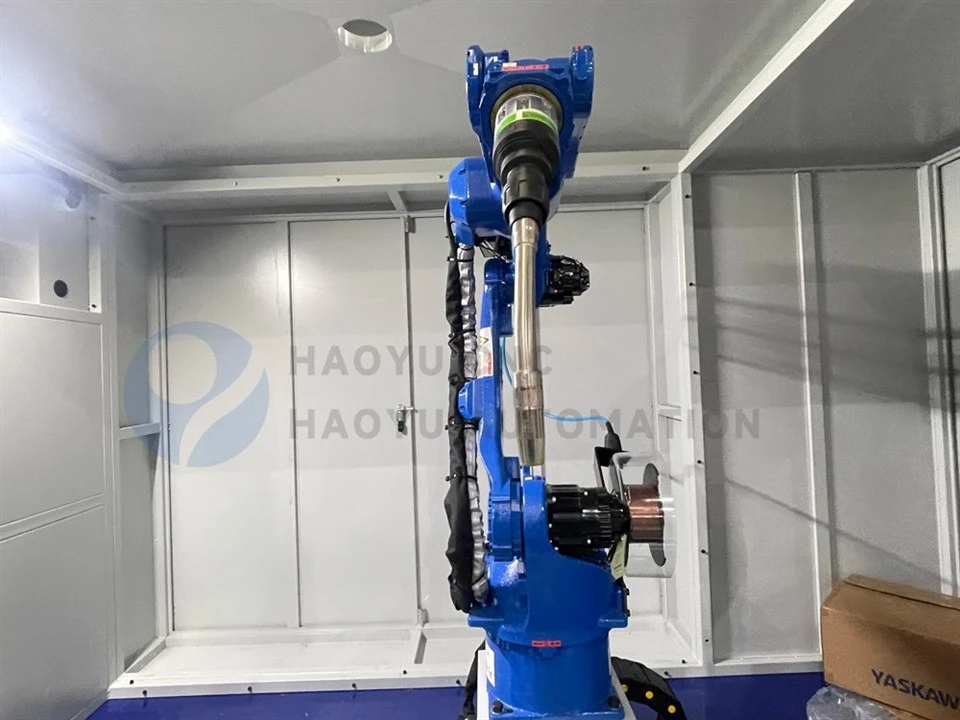
The station combines a welding robot with a main spindle chuck, tailstock center, pneumatic clamping cylinder, PLC control system, HMI, and flame preheating. The chuck and tailstock help establish a consistent setup for round workpieces. The robot follows a programmed path for each joint, and the flame preheating system heats the weld area before welding when the procedure requires it.
Piston rod robot automatic welding machine vedio for your reference:
The Tech Parameters of the robot welder on hydraulic cylinder
| Model |
NZC3R-500H-2M×300MM
|
| Workpiece length |
100-2000mm
|
| Workpiece diameter |
20mm-300mm
|
| Suitable for welding wire diameter |
φ1.0/1.2mm
|
| The average welding speed | 600 mm/min |
| Welding process | Using mixed gas shielded welding process |
| Spindle chuck |
Φ320mm
|
| Tailstock tip |
Φ150mm
|
| Control System | Omron PLC |
| Robot Systems |
MOTOMAN-AR1440 (Yaskawa)
|
What Can This Robotic Hydraulic Cylinder Welding Station Weld?
| Application | What the station welds | What matters when checking your part |
|---|---|---|
| Hydraulic cylinder barrel circumferential welding | The circular seam around the cylinder barrel | Barrel outside diameter, wall thickness, part length, and the location of the seam relative to the clamping point |
| Piston rod-end welding | The contoured intersection where the rod end joins the piston rod | Rod diameter, rod-end geometry, joint fit-up, and torch access along the contour |
| Square valve seat welding | The joint between the square valve seat and the hydraulic cylinder barrel | Seat location and orientation, the edges specified for welding, and clearance around the joint |
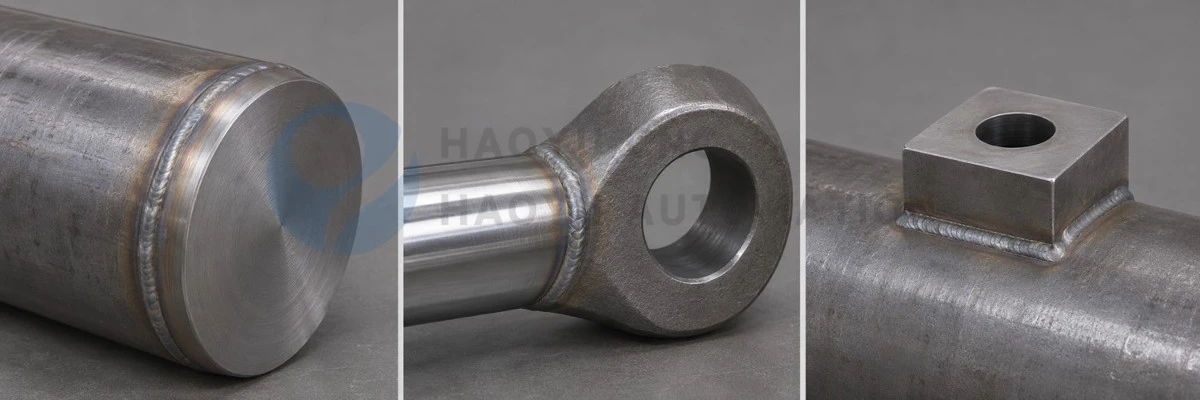
The three applications require different setups. On a barrel seam, the main consideration is how consistently the seam runs relative to the spindle axis as the part rotates. At a piston rod end, the key is keeping the contoured joint in a consistent position relative to the programmed torch path. For a square valve seat, the fixture must locate the seat on the barrel while leaving the specified weld edges accessible.If you also want to weld grease nipple components, this robot can also perform that function.
What Production Problems Does the Welding Station Address?
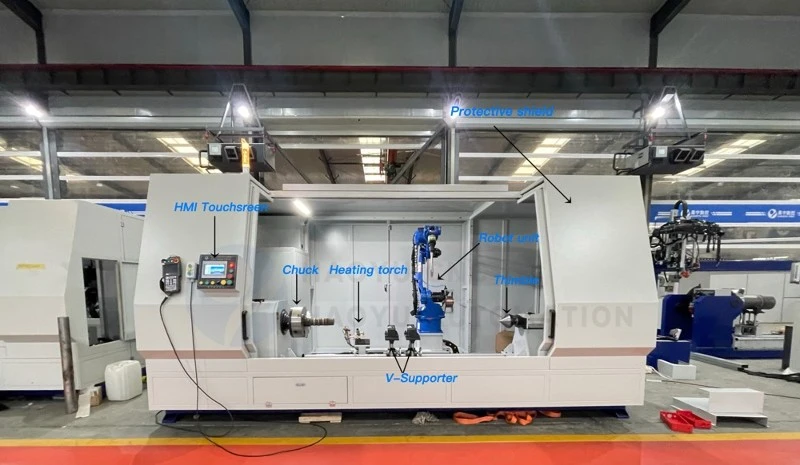
- Unstable barrels during circumferential welding. The main spindle chuck grips and rotates the barrel, while the tailstock center supports the opposite end to help keep the seam aligned with the torch.
- Inconsistent rod-end and valve seat welds. The pneumatic clamping cylinder helps hold the joint in position so the robot can repeat the programmed weld path.
- Different operating steps across shifts. The PLC manages the welding sequence, and the HMI gives operators a common interface for running the station.
- Joints that require preheating. The flame preheating system heats the weld area before welding when specified by the welding procedure.
`
Who Is This Hydraulic Cylinder Welding Machine For?
- Hydraulic cylinder OEMs bringing repeat welds into robotic production. If your team manually welds recurring barrel seams, rod-end joints, or valve seats, the station provides a way to standardize workholding and torch motion for those applications.
- Cylinder manufacturers producing several models. If barrel diameters, rod ends, and valve seat positions vary across your product line, send drawings for your main part families. The review can identify where tooling can be shared and where a separate setup is needed.
- Component suppliers focused on weld consistency across batches. If rod-end contours or valve seat locations are difficult to reproduce across parts, the station addresses both sides of the problem by holding the joint in a repeatable position and running a programmed torch path.
- Production engineers evaluating joints that require preheat. If your steel grade, wall thickness, or joint design calls for a specified preheat step, share your WPS or process requirements so the preheating setup can be evaluated for the application.
FAQ
Q:Can one robot station weld barrel seams, piston rod ends, and square valve seats?
A:Yes. The station supports all three applications. The workholding and robot program depend on the joint and part geometry. For a project that includes all three, send one representative drawing for each application so the workholding, torch access, and changeover requirements can be reviewed together.
Q:What cylinder diameter, length, and weight can the station handle?
A:Send the minimum and maximum barrel outside diameter, wall thickness, overall weldment length, and maximum workpiece weight. For piston rod-end welding, include the rod diameter and rod-end drawing. These dimensions help determine chuck grip, tailstock support, and torch access for your size range.
Q:How do you evaluate cycle time for our parts?
A:Provide the weld length, number of joints and passes, preheat requirements, and target output per shift. For production planning, the cycle-time review should account for loading, clamping, positioning, preheating, welding, and unloading. If several models will share the station, include your expected product mix so changeover can be considered.
Q:Can the station work with our existing welding procedure?
A:Provide your WPS or weld specification with the part drawings. Include the base material grades, shielding gas blend if specified, weld size, preheat requirements, and inspection criteria. These details help determine how the mixed-gas shielded welding process and workholding setup would be applied to your parts.
Our Services
Jinan Haoyu Automation System Co., Ltd. is a welding machinery maker in Jinan China . We have a strong design and technical team and can design and manufacture the machines as customer's requirements. In addition, SUN RISING TRADE PTE.LTD, as the Singapore branch of Jinan HAOYU ,is the global sales and after-sales service representative of Haoyu Automation Group , focusing on the sales and service of high-end welding automation equipment.
Warranty: 12 months from the date of Bill of Lading.
The Seller shall bear responsibility for the entire machineries normally working during 12 months from the date of Bill of Lading. During warranty period, if are damages and disorders of equipment due to machine quality, The Seller shall be responsible for replacement of the defective parts with new parts. The warranty shall also include performance functions as defined in the offer. In the case that there is any defect The Buyer shall inform The Seller in writing and photos of the broken parts. The Seller will assist and deal with such damages within 15 days from receipt of The Buyer's above information.
The Seller doesn't guarantee the spare parts which are easily worn out / damaged. The Seller deems it his responsibility to furnish The Buyer these spare parts at prices reasonable or agreed.
The Seller doesn't guarantee equipment in case faults caused by operators' improper operation or electric source's breakdown.
Service condition:
1) When Sellers send engineer to Buyer's place for Installation, Commissioning and training for the machine in this contract in Buyer's place, Buyer shall undertake all the relative fees like, all tickets, accommodation for Seller's engineers.
2) Seller shall, within one week of receiving the above information, provide the required and qualified personnel to undertake supervision of installation, commissioning and training.
3) If the Buyer needs the service after sales from Seller, then Buyer shall undertake all the relative fees, like Round Tickets, Accommodation, Internal and international transportation, Labour cost of engineers etc.
4) When the Seller's engineer carries out the services in Buyer's place, Buyer shall arrange a Translator that can speak Chinese for Seller's engineer.
5) Labour cost for engineers: 100.00 USD per person, per day.
Our Certification
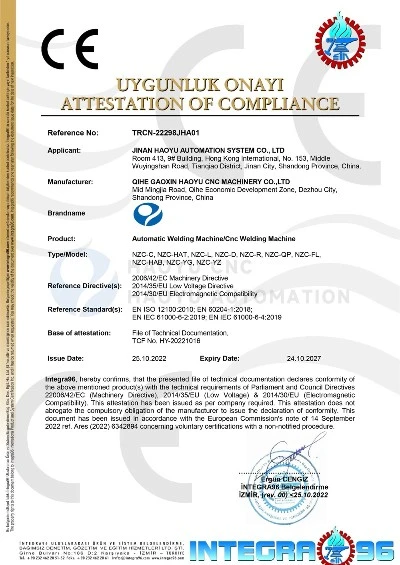
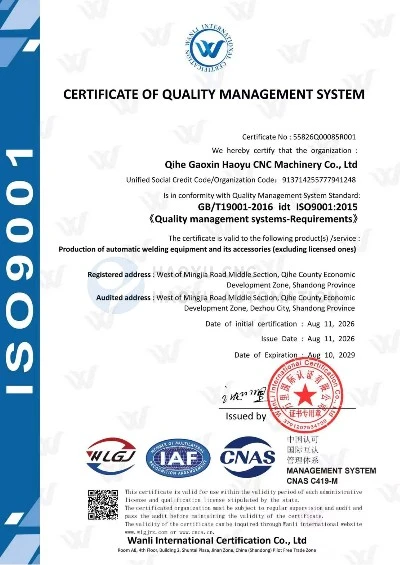
Hot Tags: hydraulic cylinder welding machine with robot station, China, manufacturers, suppliers, factory
Send Inquiry
You Might Also Like


