
How To Choose A Longitudinal Seam Welder For Tanks
Leave a message
Choosing a longitudinal seam welder is not simply a matter of comparing welding length, travel speed and price.
For tank and cylinder manufacturers, the more important question is whether the machine can handle the actual workpiece, maintain joint alignment, produce the required weld quality and achieve the planned production output.
This is particularly important when purchasing customized equipment from an overseas supplier. A machine may appear suitable in a quotation but still fail to meet expectations if the workpiece details, welding procedure and acceptance requirements have not been clearly defined.
This guide explains how to choose a longitudinal seam welder and what information buyers should confirm before placing an order.
1.Start With the Workpiece, Not the Machine
The correct machine configuration begins with the part that needs to be welded.
Before requesting a quotation, prepare the following information:
- Minimum and maximum workpiece diameter
- Total workpiece length
- Required longitudinal weld length
- Workpiece weight
- Material grade
- Minimum and maximum wall thickness
- Joint design and gap
- Location of the weld
- Available loading direction
- Product drawings or photographs
Do not provide only one sample size if your factory produces several tank or cylinder models. The supplier must evaluate the complete product range to determine whether one machine can accommodate all required sizes.
A reliable longitudinal seam welder manufacturer should evaluate the combination of diameter, length, weight and loading method-not just confirm that each individual value is within the machine's stated maximum capacity.
2.Define the Required Weld Result
Different customers may have very different definitions of an acceptable weld.
For some products, appearance is the main concern. For pressure-bearing tanks or cylinders, penetration, strength, deformation and leak-test performance may be more important.
The buyer should specify:
- Required weld penetration
- Acceptable weld appearance
- Maximum permitted deformation
- Whether back-side protection is required
- Whether the weld will be inspected
- Required inspection or testing method
- Applicable production or customer standard
Avoid using descriptions such as "good welding quality" or "beautiful weld." These terms are too subjective for machine design and acceptance.
Where possible, provide a sample of an acceptable welded part or a written weld-quality standard. This gives the machine supplier a measurable target.
3.Match the Welding Process to the Application
The welding process should be selected according to the material, thickness, joint design, required quality and production speed.
Common considerations include:
1.TIG welding is often selected when weld appearance, arc control and low spatter are important.
2.MIG/MAG welding may be considered when higher deposition rates and production output are required.
3.Submerged arc welding is generally used for suitable medium- or heavy-thickness components with long welds.
4.Laser welding may provide high travel speed and a smaller heat-affected zone, but normally requires accurate joint preparation and alignment.
The fastest process is not automatically the best choice. Weld preparation, allowable distortion, consumable cost, operator experience and inspection requirements must also be considered.
If the welding process has already been approved by your customer or engineering department, include the welding procedure with the inquiry. If it has not been determined, ask the supplier to recommend a process based on sample welding and technical evaluation.
4. Pay Attention to Clamping and Joint Alignment
Many longitudinal welding problems are caused by workpiece positioning rather than the welding power source.
A long joint may move, open or distort as heat is introduced. If the two edges are not held in the correct position, the torch may no longer follow the center of the joint.
When evaluating a longitudinal seam welder for tanks, ask the supplier to explain:
- How the workpiece is loaded and supported
- How the joint is aligned before welding
- How clamping pressure is applied
- How different diameters are accommodated
- Whether the backing device is required
- How thermal distortion is controlled
- How the finished workpiece is unloaded
The fixture should be designed around the actual workpiece. A general machine fitted with an unsuitable fixture may create long setup times, unstable alignment and unnecessary rework.
5.Evaluate the Complete Production Cycle
Welding speed alone does not represent production capacity.
The complete cycle may include:
- Loading the workpiece
- Positioning the joint
- Clamping
- Moving the torch to the starting position
- Welding
- Cooling or waiting time
- Releasing the fixture
- Unloading the workpiece
For example, a high welding travel speed provides limited value if operators spend several minutes aligning and clamping every part.
Ask the supplier to estimate the complete cycle time using your actual workpiece. If several sizes will be produced, also confirm the changeover time between different models.
Buyers planning batch production should pay particular attention to repeatable positioning, stored welding programs and simple parameter adjustment.
6. Confirm the Level of Automation
Not every factory requires the same level of automation.
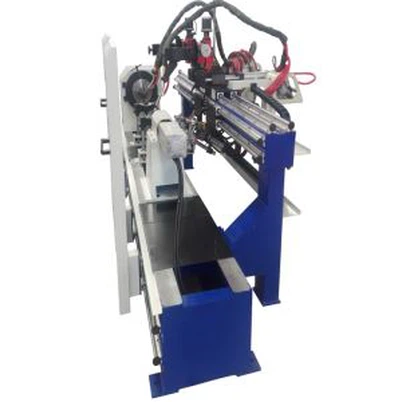
A basic machine may control only welding travel. A more advanced automatic longitudinal seam welding machine may coordinate clamping, torch positioning, welding parameters and cycle completion.
Before selecting the controls, consider:
- Required daily production volume
- Number of different workpiece models
- Frequency of product changeovers
- Operator skill level
- Need to save and recall welding programs
- Need to monitor or record process parameters
- Future connection to other production equipment
More automation can improve repeatability, but it can also increase cost and system complexity. The correct solution is the level of automation that supports the required production process without adding unnecessary functions.
7.Request Sample Welding and an Acceptance Plan
Overseas buyers cannot rely only on product photographs, catalogues or demonstration videos.
Before manufacturing begins, both parties should agree on how the machine will be tested and accepted.
The acceptance plan should define:
- Test workpiece dimensions and material
- Joint preparation
- Welding process and consumables
- Target welding speed
- Required weld appearance
- Penetration requirements
- Inspection method
- Permitted deformation
- Cycle-time target
- Functions that must be demonstrated
Where practical, send representative workpiece samples to the supplier for welding trials. The test should use material, thickness and joint conditions similar to actual production.
Buyers should request photographs, welding videos and inspection results. For important projects, a factory acceptance test can be completed before shipment according to the agreed technical specification.
8. Confirm Installation Requirements
A machine suitable for the supplier's factory may not be ready for the customer's production site without additional preparation.
Overseas buyers should confirm:
- Local voltage, phase and frequency
- Required electrical capacity
- Compressed-air requirements
- Shielding-gas requirements
- Cooling-water requirements
- Machine dimensions and weight
- Foundation or floor requirements
- Door and container access
- Installation responsibilities
- Operator and maintenance training
These details should appear in the technical agreement. Confirming them before production helps avoid installation delays and unexpected modification costs after delivery.
9. Check Documentation and After-Sales Support
For customized welding equipment, after-sales support is part of the purchasing decision.
Ask the supplier what will be provided with the machine:
- Operation manual
- Electrical drawings
- Pneumatic or hydraulic diagrams
- Recommended spare-parts list
- Maintenance instructions
- Welding parameter guidance
- Remote technical support
- Installation and commissioning service
- Operator training
- Warranty scope and period
Also confirm which wear parts and electrical components should be kept in stock. This is especially important for international customers because replacement-part delivery may take longer.
Using internationally available electrical and control components can make future maintenance easier, but the approved brands and models should be listed in the quotation or technical agreement.
10. Compare Technical Scope, Not Only Price
Two quotations for a custom longitudinal seam welder may describe very different systems.
A lower price may exclude the welding power source, fixture, cooling system, installation, sample testing or spare parts. Another quotation may include these items.
When comparing suppliers, check whether each quotation clearly defines:
- Machine working range
- Included welding equipment
- Fixture and clamping scope
- Control functions
- Loading method
- Safety devices
- Testing and acceptance
- Documentation
- Installation and training
- Spare parts
- Delivery terms
- Warranty and technical support
The best quotation is not necessarily the lowest-priced one. It is the quotation that clearly matches the workpiece, quality requirements and planned production process.
Conclusion
Understanding how to choose a longitudinal seam welder helps buyers avoid selecting a machine based only on maximum dimensions, welding speed or price.
The correct solution should match the workpiece range, maintain joint alignment, support the required welding procedure and deliver repeatable results under real production conditions.
For overseas projects, sample testing, acceptance standards, installation requirements, documentation and after-sales support should be confirmed before the machine enters production.
If your tank or cylinder requires a non-standard diameter, welding length or fixture, view our custom longitudinal seam welder and send HAOYU your workpiece drawing for evaluation.
You can also compare our complete range of automatic longitudinal seam welding machines for different materials, welding processes and applications.