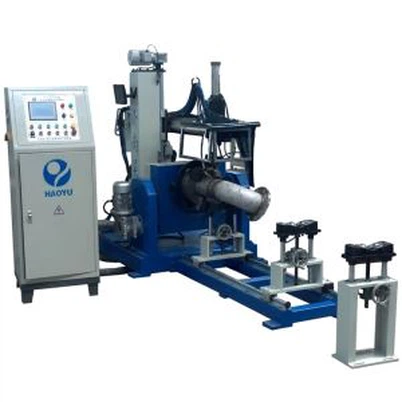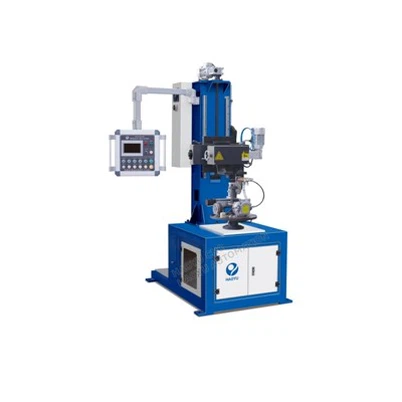



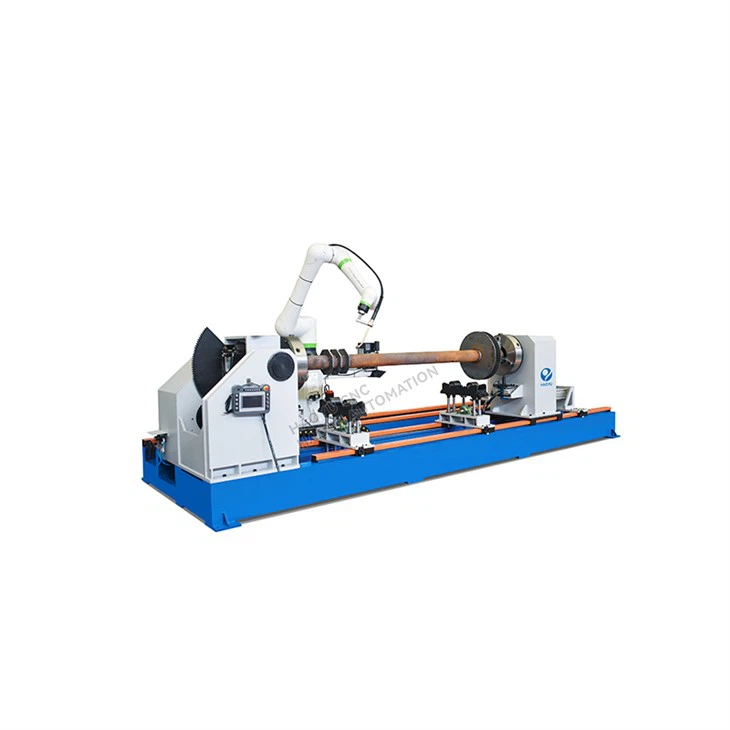


Automatic MAG Robotic Pipe Flange Welding Machine
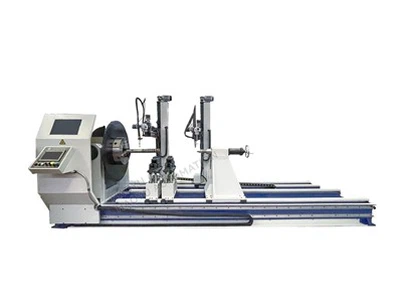
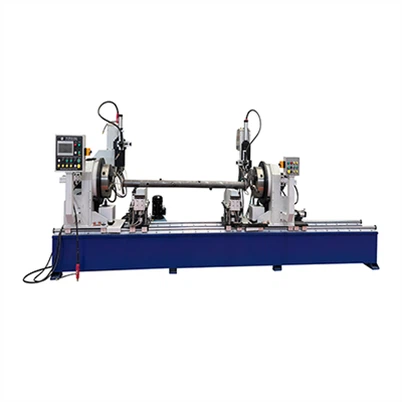
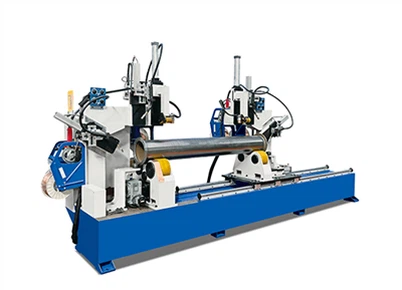
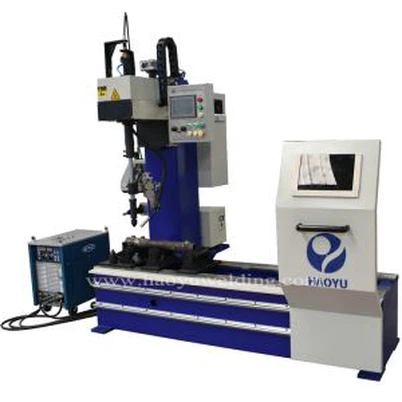
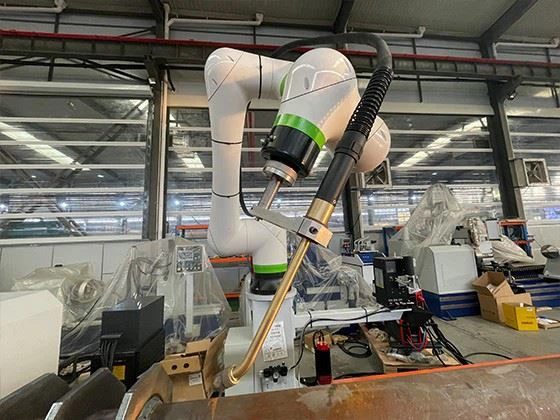
This equipment typically consists of an industrial robot, a high-precision positioner, a dedicated welding power source, and an integrated control system. It can automatically load, center, and weld flanges, significantly improving welding efficiency and consistency.
Description
Automatic MAG Robotic Pipe Flange Welding Machine

I. Main components
Robotic flange circular seam welding machine
1.Cylinder-driven positioning mechanism
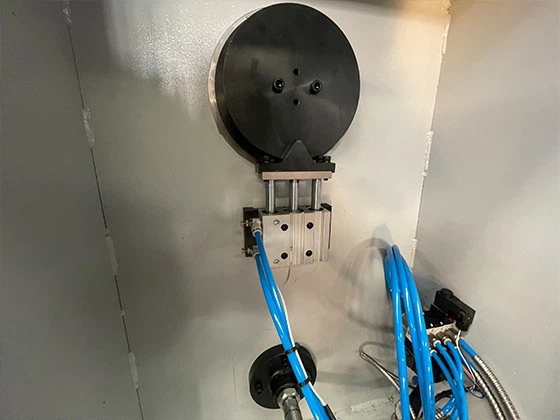
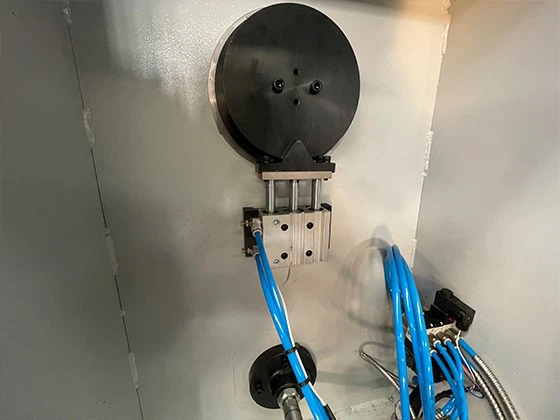
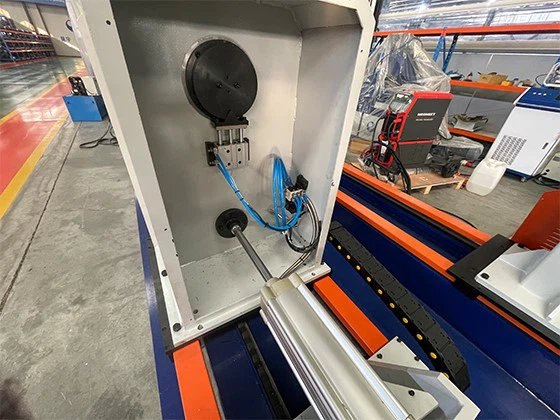
The tailstock is equipped with a rotary positioning system, which employs a precision cylinder-driven positioning mechanism. The core function of this mechanism is to enable rapid switching of the tailstock's operating modes: when the welding process requires the workpiece to remain stationary, the control system issues a command to drive the cylinder piston rod to quickly push upwards. The piston rod tip is typically designed with a high-strength, wear-resistant locating pin or key, which precisely inserts into a pre-set corresponding slot or keyway on the tailstock's rotating components, forming a mechanical rigid interlock. This pin-type locking effectively eliminates rotational freedom, ensuring that the tailstock and workpiece remain absolutely stationary during welding, providing a stable reference for robotic welding and greatly guaranteeing the coaxiality and welding quality of the flange circumferential weld. When rotation is required to resume, the cylinder retracts the locating pin, and the tailstock can then be freely rotated by the drive motor. The chuck is also equipped with a cylinder drive device and similar functions. However, unlike the former, a hydraulic cylinder device is installed here. Its purpose is: when the pin at the top of the piston rod inserts into the corresponding slot in the chuck, the hydraulic cylinder drives the pin to rotate, thereby controlling the clamping and loosening of the chuck.The fixture can be customise according to customers' requirements.


2.The movable tailstock
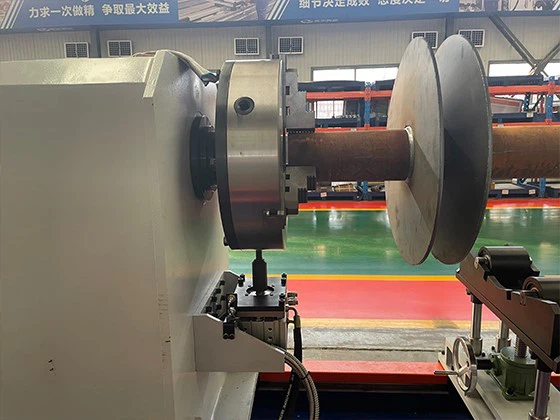
The tailstock is mounted on a precision guide rail on the machine body, and its core driving force comes from a high-performance cylinder. During the automated welding cycle, the cylinder operates according to programmed instructions, driving the entire tailstock to slide smoothly along the guide rail, reliably clamping the pipe fittings and flange assemblies to be welded, ensuring extremely high positioning rigidity and concentricity during welding. After welding is completed, the cylinder reverses its direction, and the tailstock immediately releases and returns to its original position, facilitating quick workpiece removal and clamping of the next workpiece.

3.The supprting frame
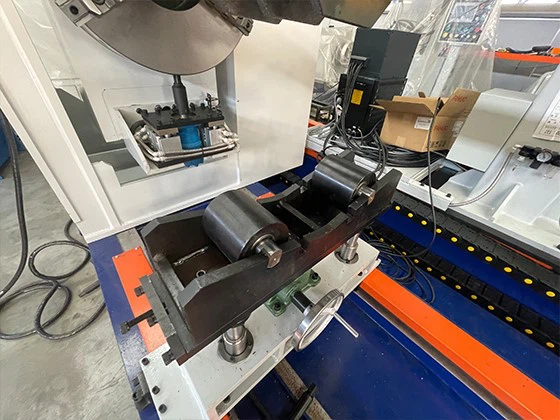
The supporter is specifically designed for cylindrical workpieces. Its main body features a stable V-shaped structure, reliably supporting and positioning pipe fittings and flanges. Low-resistance rollers are installed at the top of the rack, allowing for easy adjustment of the workpiece to its optimal position before welding. Furthermore, the overall height of the rack can be flexibly and precisely adjusted manually by turning a handwheel, quickly adapting to workpieces of different sizes and effectively cooperating with robotic welding operations.

4.The Spindle box
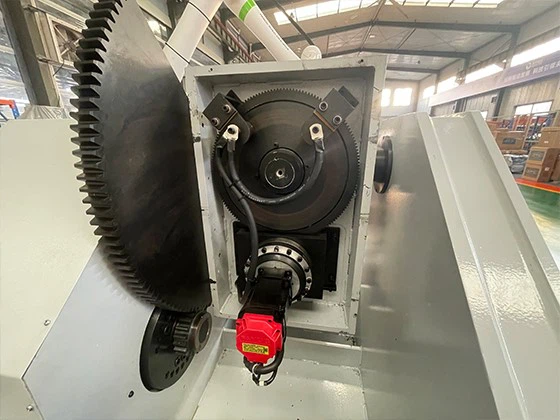
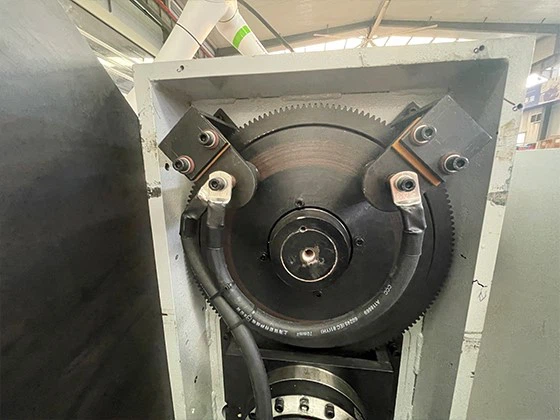
The servo motor powers the spindle, ensuring precise rotational control during welding to meet stringent welding process requirements. The conductive pad provides a stable and reliable path for the welding current through sliding contact, while allowing continuous energization of the spindle during rotation, ensuring the continuity and stability of the welding arc.
5.Industrial robot systems
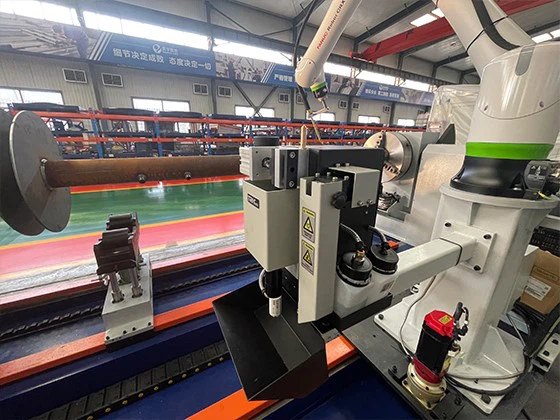
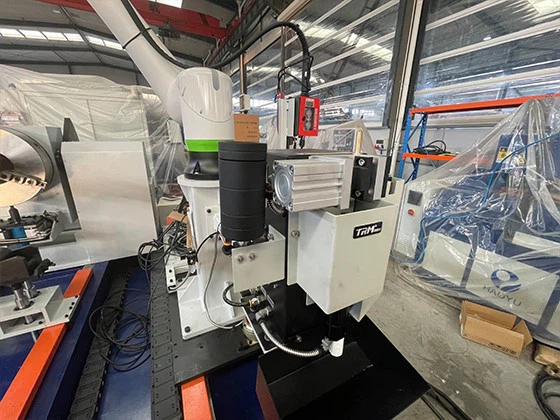
The robot body is mounted on a robust linear guide rail and is precisely driven and controlled by servo motors. The servo motors respond quickly and smoothly to commands, driving the robot to accurately move along the guide rail to the preset welding workstation. This design significantly expands the robot's working range, enabling continuous and precise positioning of multiple flange weld locations.


6.The torch clear station
Primarily used for the automated cleaning and maintenance of welding torches. This workstation is typically integrated within the robot's working range. After completing a certain welding duration or for routine maintenance, the robot automatically moves the welding torch to the cleaning station. Its core functions include: precisely cutting the welding wire using a wire-cutting mechanism to eliminate spherical residue at the weld tip; protecting the nozzle interior by spraying silicone oil or anti-spatter agent; and removing welding spatter adhering to the inside and outside of the nozzle using a cleaning brush or pneumatic scraper.
7.The flipping mechanism
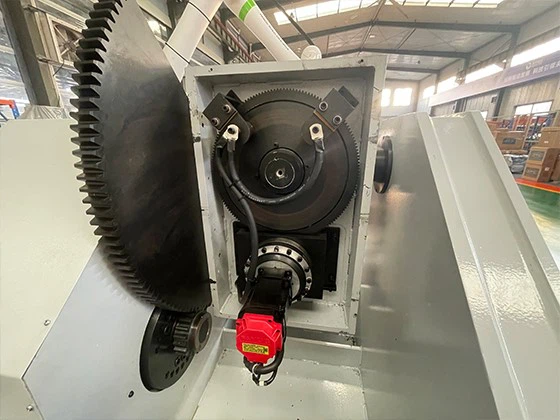
This mechanism uses a servo motor as the drive source, ensuring high-precision, programmable control of rotational speed and angular position. Its transmission system consists of a pair of gears, one large and one small. Typically, the small gear is mounted on the servo motor's output shaft as the driving gear, while the large gear is connected to the rotary table or fixture that carries the workpiece. This reduction gear pair design effectively amplifies the servo motor's output torque to meet the requirements of heavy workpiece tilting, while also further ensuring the smoothness and positioning accuracy of the workpiece's rotational motion.

II. Working Process
MAG Stainless Steel Pipe Flange Welder With Robot
1.Loading and Clamping: The operator hoists or places the spot-welded pipe-flange assembly onto the special machine fixture and activates pneumatic or hydraulic clamping.
2.Program Selection/Recall: Select the program corresponding to the workpiece model on the HMI (or use automatic recognition).
3.Automatic Welding:
- The system starts. The positioner rotates the workpiece to the starting position.
- The robot/welding torch moves to the arc ignition point.
- Automatic welding begins (usually multi-layer, multi-pass welding). The positioner rotates continuously at a constant speed, and the welding torch may oscillate.
- Welding completes. The arc is extinguished, and the welding torch returns to the safe position.
4.Unloading: The fixture releases, and the operator removes the welded workpiece.
III.Typical applications
Automatic Tube Circuferential Seam Welding Equipment
- Petrochemical Industry: Pressure pipelines, valve and flange assemblies.
- Shipbuilding: Ballast water systems, prefabricated fire protection piping.
- Electric Power Boilers: Header fittings, economizer fittings.
- Municipal Engineering: Large-diameter water treatment pipelines, steel structural components.
IV. Vedio for your reference
IV.Package
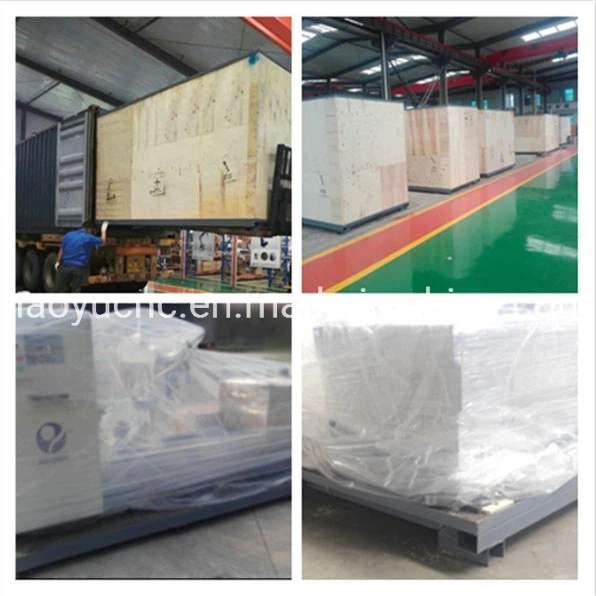
1.Normally we will use fumigation plywood case for packaging; for some big machine, we can use steel pallet and plastic filme cover.All machines are paint with anti rust paint or oil before leaving factory.
2.Package can be as customers' requirement.
V. Sales term
- Payment term: 30% T/T advance along with the purchase order, balance should be cleared before delivery
- Delivery time: 45 days on receipt of payment in advance
- Guarantee: 12 months for the whole machine
Hot Tags: automatic mag robotic pipe flange welding machine, China, manufacturers, suppliers, factory
Send Inquiry
You Might Also Like